|
THE JEWISH WORLD
Medal Released to
Mark 20th Anniversary of Operation Moses
The State of Israel
marked the 20th anniversary of Operation Moses, in which 8,000 Jews made
aliya from Ethiopia, by releasing a medal honoring Ethiopian Jewry’s
remarkable culture and difficult journey to Israel.
Each side of the
medal was designed by an Ethiopian artist selected by a public committee
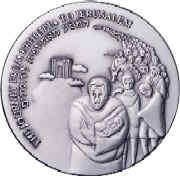
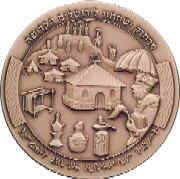
of community leaders and artists. Elias Yosef designed the side
illustrating the community’s immigration to Israel and Alemu Eshetie
designed the side depicting life in Ethiopia. The Israel
Government Coins and Medals Corporation is producing the medal in gold
and silver in limited editions and in bronze and expects it to become a
collector’s item.
The front of
the medal benefits from the fact that Yosef, a graphic artist who is a
graduate of the prestigious Bezalel Academy of Art and Design in
Jerusalem, clearly remembers the difficult journey he made from Gondar,
Ethiopia, to Israel when he was 12.
“I wanted to portray
how difficult the journey was,” he said, noting that the most difficult
part was the loss of family members who died on the way, particularly
when it was a mother, the pillar of the family. Therefore, the central
image is immigrants ascending to Jerusalem led by a widowed father
holding a baby. He is followed by people who support one another,
reflecting the inspiring solidarity of the community in the face of
hunger, disease, robbery, kidnapping and the many other dangers involved
in the journey. Above them hovers a dreamlike image of the Temple in
Jerusalem, which sustained them throughout the journey.
“I appreciate the
significance of this medal – producing a medal is a way to preserve
history. This medal marks a historic event that I was part of and it is
good to know that there is greater awareness in the general public about
this event,” Yosef added.
Eshetie, who
immigrated to Israel from Gondar when he was 21, is well known in the
Ethiopian community for his ceramics and illustrations of life in
Ethiopia, particularly his illustrations for children.
“All of my drawings
are very connected to Ethiopian Jewry and so I was invited to a meeting
to help pick artists to design the medal. Instead, I entered the
competition and was selected to design one side of it myself,” he said.
“For me, the medal
closes a circle. It tells my family’s personal story and also my
community’s story. It was a great honor to be involved in producing it,”
he added.
He created a general
picture of community life. As the synagogue was central to Jewish life,
it is in the center of the medal and a kes (Ethiopian rabbi)
stands alongside it. They are surrounded by the village, consisting of
typical homes and a small structure in which women stay during nida
(the time of month when women are considered ritually impure). This is
accompanied by symbols of the trades that sustained the community, and
Eshetie’s immediate family: pottery; making clothes; metalworking; and
embroidery. In the background, kesim observe the Seged holiday by
ascending the highest mountain in the vicinity to pray for Jerusalem and
express their desire to return to it. Around the edge of the medal are
the words of a prayer, in the liturgical language of Ge’ez and in
Hebrew, expressing yearning for Jerusalem.
The Israel
Government Coins and Medals Corporation is producing 180 medals in 14
karat gold (30.5 mm., 17 gr.) that sell for $525; 500 sterling silver
medals (50 mm., 49 gr.) that sell for $75; and bronze medals (70 mm.,
140 gr.) that sell for $39. Sets of all three medals are $579. The
medals are available at the corporation’s stores in Jerusalem (5 Ahad
Ha’am Street), Tel Aviv (42 Ben Yehuda Street), Haifa (Lev Hamifratz
Mall), Beersheva (91 Herzl Street), and Ra’anana (5 Jabotinsky Street)
and also can be ordered online at
www.isragift.co.il.
Part of the proceeds
from the medals’ sale will go toward building a memorial to the
thousands who died on the journey from Ethiopia to Israel. |